

YOUR PATH TO BECOMING A FREAK ATHLETE
Stop following generic strength programs that limit long-term growth. Join a training system built to target each athlete’s unique needs, backed by world-class results.








YOUR PATH TO BECOMING A FREAK ATHLETE
Stop following generic strength programs that limit long-term growth. Join a training system built to target each athlete’s unique needs, backed by world-class results.


“I'm getting programming from the same coaches as several Olympic athletes but customized to suit my abilities, schedule, and equipment access. Always looking forward to my next workout.”
-Andrew Sobiesiak
Real Athletes. Proven Results.
See what’s possible when dedication meets a training system built on real results.
Athletic Fitness
Craig Curtis

Softball
Sarah Helen Davis
Wrestling
Deandre Nunn
Football
Isaiah Thomas
Athletic Fitness
Craig Curtis
Softball
Sarah Helen Davis
Wrestling
Deandre Nunn
Football
Isaiah Thomas
don’t take our word for it

I’ve been strength training for over 14 years and nothing has been as streamlined as this. It’s clear you put your heart and soul into this and I appreciate it.

Lee P
I've seen massive improvements in my son's strength and explosiveness. Also dropped 20lbs training with him.

davecubsrule
Been a user of the app since it launched. It's changed my life. Can't thank you enough coach.

nickw6321
I look forward to each workout and always get excited to push myself in each workout. As a former D1 athlete and National Champion, I've missed training as an athlete and the Universal Training Athlete program has me feeling like I could come out of retirement.

Nick S
All in all this gave me exactly what I needed in an organized, and fun way to get back into training. I gained 15 lean pounds along with some of the fat and am back to feeling powerful.

GatoDeMeurto
I started Peak Strength for my son for football. His squat has gone from 205 to 270 in just two months.

backtoroots779
Yo, I gotta say, y'all did something right making the app! I've been using it for over half a year and my numbers have been going up so well. The weights that were my one rep max I wouldn't have thought I'd be hitting them for doubles or triples as soon as I did.

Mason H
Just for a bit of background, I’m a retired national champion swimmer and Peak Strength got me properly back into training because it’s hands down the best sports-focused training program I’ve seen.

Mike C
I’ve been strength training for over 14 years and nothing has been as streamlined as this. It’s clear you put your heart and soul into this and I appreciate it.
Lee P
I've seen massive improvements in my son's strength and explosiveness. Also dropped 20lbs training with him.
davecubsrule
Been a user of the app since it launched. It's changed my life. Can't thank you enough coach.
nickw6321
I look forward to each workout and always get excited to push myself in each workout. As a former D1 athlete and National Champion, I've missed training as an athlete and the Universal Training Athlete program has me feeling like I could come out of retirement.
Nick S
All in all this gave me exactly what I needed in an organized, and fun way to get back into training. I gained 15 lean pounds along with some of the fat and am back to feeling powerful.
GatoDeMeurto
I started Peak Strength for my son for football. His squat has gone from 205 to 270 in just two months.
backtoroots779
Yo, I gotta say, y'all did something right making the app! I've been using it for over half a year and my numbers have been going up so well. The weights that were my one rep max I wouldn't have thought I'd be hitting them for doubles or triples as soon as I did.
Mason H
Just for a bit of background, I’m a retired national champion swimmer and Peak Strength got me properly back into training because it’s hands down the best sports-focused training program I’ve seen.
Mike C
MEET DANE MILLER
I founded Garage Strength to prove that anyone can train like an athlete. From high school thrower to international coach, I’ve developed a system that helps everyday people and elite competitors alike become their strongest, fastest, and most capable version of themselves.
Garage Strength Methodology

athlete-specific
Every program is tailored to the individual, emphasizing the four pillars of athleticism, Strength, Explosiveness, Speed, and Endurance, in the exact balance required for their sport.

Hybrid Approach
The system draws from Olympic Weightlifting, Powerlifting, Bodybuilding, and Plyometrics, blending the best of each discipline to build complete athletes.

Data-Driven
Key movements are regularly tested to provide objective feedback. This data validates progress and refines programming to drive evidence-based decisions.

Strategic Variation
Athletes stay engaged and adaptable through structured exercise variations and rep schemes, while never losing sight of the foundational lifts that drive long-term growth.
single leg squat stand
Master the single leg squat with the most heavy duty roller stand on the market. Single legs squats are our #1 rated piece of equipment for sport-specific strength and speed development.
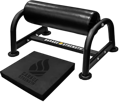
single leg squat stand
Master the single leg squat with the most heavy duty roller stand on the market. Single legs squats are our #1 rated piece of equipment for sport-specific strength and speed development.
Ready to train like a champion?
Get personalized programming built for long-term strength, speed, and performance, not generic results.